

The Town of Apex operates with a defining mission: to provide exceptional public service that cultivates opportunity for individuals and the community to live, thrive, and reach their peak. Deeply committed to transparency and community input, the town manages a complex network of municipal infrastructure, from storm drains to curbside yard waste.
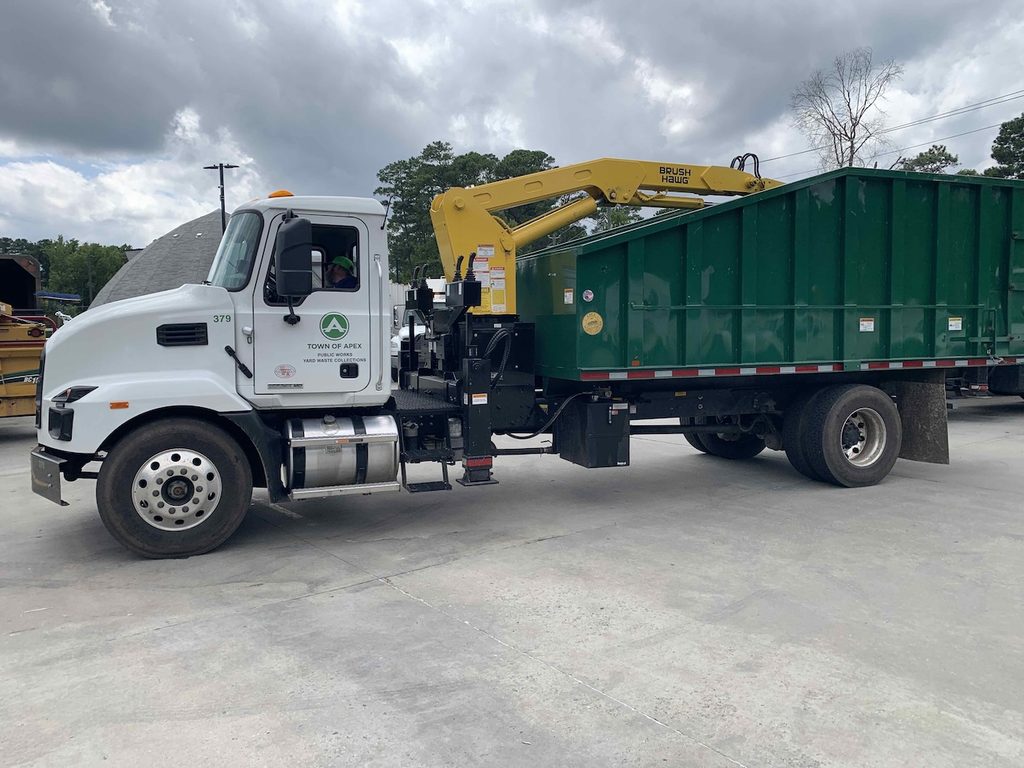
To uphold these high service standards and modernize daily operations, Apex relies on forward-thinking leaders across its departments. Recognizing the need for a smarter operational workflow for roadways and right-of-ways, a collaborative, cross-functional team, featuring Fleet Services Manager Bill Spare, Solid Waste Manager Brandon Roberson, GIS Analyst Kelsey Hulse, and John Mullis, spearheaded an exploratory technology initiative with Raven Connected, understanding how the automated solution would directly benefit their respective departments and the residents they serve.
Before implementing the Raven Ground Source Truth platform, tracking compliance relied heavily on manual labor. Staff physically drove routes, visually estimated yard waste, and manually reviewed footage, creating inefficiencies that conflicted with the town’s commitment to transparent, proactive public service.
The Challenge: Ordinance Changes and Manual Bottlenecks
The tipping point arrived when Apex proposed eliminating curbside grass disposal and introducing a fee structure for yard waste piles exceeding two cubic yards. This operational shift exposed vulnerabilities:
- The Reliance on Judgment Calls: Driver estimates for waste volume left room for human error. This lack of verifiable data drained labor hours and created friction with residents, directly challenging the town’s core value of transparency.
- Legacy System Blind Spots: Existing workflows failed to provide automated volume measurements or accurately differentiate between curbside materials like grass, leaves, or branches.
The Solution and Impact: Proving Value in the Field
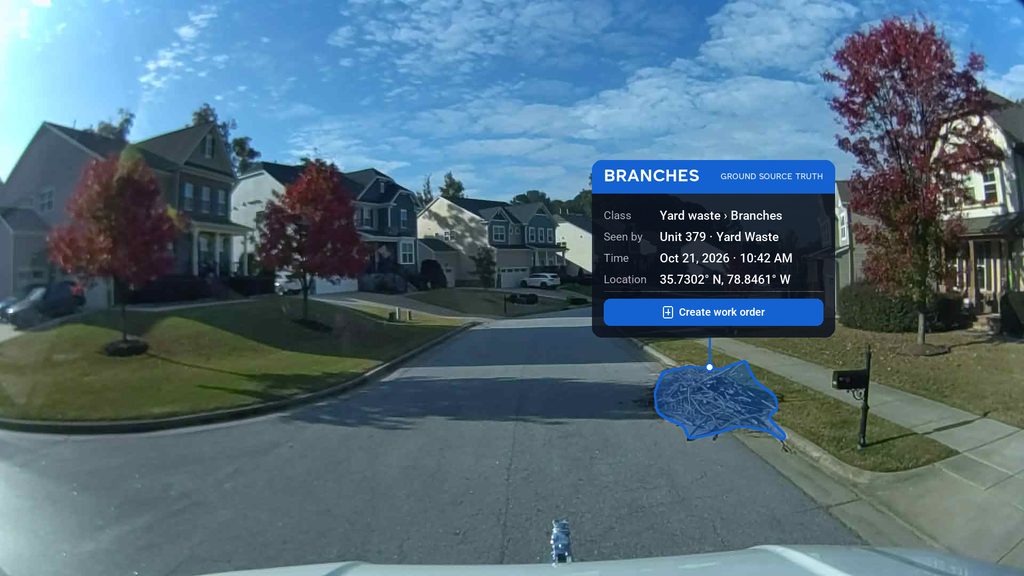
To solve these bottlenecks, the cross-functional team initiated a 4-month strategic and technical alignment phase, equipping 13 vehicles with Raven’s lightweight OBUs through their Innovation Partnership Program. Rather than adopting a basic system that simply flags objects (an “I see a leaf pile” alert), Apex leveraged Raven’s multi-layered AI solution that drives a complete operational workflow.
By acting as an automated “inspector,” the technology saves substantial labor hours and eliminates manual field routing through three distinct levels of intelligence:
- Level 1 — Classify and Segment: Raven goes beyond simple detection to accurately identify and segment complex curbside materials, dynamically filtering classifications such as mulch, light grass, auburn grass, dark brown leaves, and branches.
- Level 2 — Characterize: The system evaluates the physical properties of what it sees. The team now generates 3D depth maps to accurately estimate and characterize exact pile volumes in cubic yards.
- Level 3 — End-to-End Workflows: By combining these multi-layered detections with vehicle telematics, the GIS team quickly ingests the high-volume point data directly into their ArcGIS Online environment to seamlessly drive compliance checks and reporting.
- The “Aha!” Moment: Showcasing a 3D model of a “volcano” grass pile that accurately measured volume (Level 2) while simultaneously identifying adjacent fixed assets (Level 1) resulted in immediate operational buy-in across the staff.
The Road Ahead: Scaling Municipal Innovation
Over the next one to three years, Apex aims to transition to 95-gallon cart collections by July 2028, working with Raven to train the AI to detect specific markers on trash, recycling, and yard waste carts. They also plan to expand their work to map road conditions including pavement condition assessment and explore Vision Zero safety initiatives.
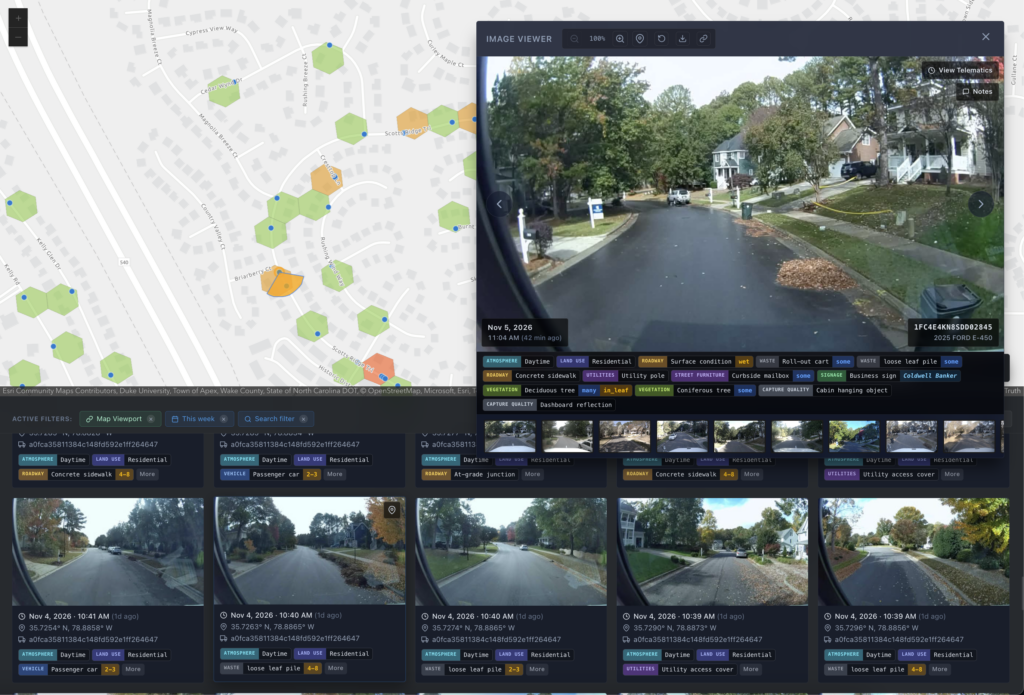
“We started by looking for a solution to a specific yard-waste challenge, but the pilot has helped us see broader possibilities. This technology could support future work with cart-based collection, road conditions, and other municipal services.” — Bill Spare, Fleet Services Manager
For other municipalities, the Apex team’s experience is clear: leveraging automated AI with a proprietary dataset removes subjective judgment, protects drivers, and generates verifiable, transparent data that successfully justifies operational decisions to the town council and the community. Raven’s AI-powered technology further streamlines these workflows by automating data collection and analysis, helping municipalities move from field observations to actionable, reliable solutions faster and with greater consistency.


Comments are closed