
Executing the Vision for a Connected Capital
The District Department of Transportation (DDOT) operates with a clear, ambitious mission: to be a national leader in creating safety and mobility solutions for the existing and emerging transportation challenges within our community. Their vision prioritizes building safer infrastructure and utilizing innovative technologies and strategies to reduce congestion, lower emissions, and connect residents to economic opportunities.
In keeping with this vision, DDOT joined the Raven Innovation Partnership Program to explore how Raven’s connected vehicle technology could help them address several critical pain points standing in the way of those goals. By deploying Raven’s plug-and-play devices, DDOT has started to blend infrastructure monitoring, Vehicle-to-Everything (V2X) communications, and AI-video telematics into a unified ecosystem.
Crucially, this wasn’t just an IT initiative. From the very beginning, DDOT brought together their GIS team, the Performance team, Intelligent Transportation Systems (ITS), and V2X leaders. They launched an initial pilot with a subset of their vehicles equipped with Ravens, to assess what impact these solutions could have across their state.
The Challenge: Doing More with Less in a Sprawling Metropolis
Before implementing Raven, DDOT faced several highly manual, labor-intensive challenges that drained resources and slowed response times, threatening their goal of equitable infrastructure maintenance across all wards:
- The Pothole Problem: DDOT receives approximately 3,500 pothole repair requests yearly from residents. Relying strictly on this complaint-driven workflow meant crews were deployed reactively.
- Post-Storm Blind Spots: Following severe summer storms, DDOT’s Urban Forestry team faces a monumental task. Crews spend long, grueling hours blindly scouring the city to locate fallen branches, debris, and major safety hazards.
- Fragmented Workflows: The agency needed a way to collect this vital infrastructure data without buying a fleet of specialized survey vehicles or forcing field workers to learn complicated new software.
The Solution: Passive Data Collection and Value Stacking
DDOT approached these challenges through a philosophy of ‘value stacking,’ utilizing a single piece of hardware to power a comprehensive suite of solutions. Because Raven controls the full tech stack, distinct data can be intelligently routed to various Raven platforms, allowing different departments within the DOT to pull relevant insights simultaneously.
Led by John Thomas, Chief Performance and Innovation Officer, DDOT turned those pilot vehicles into a roving network of virtual infrastructure inspectors. As drivers travel their standard routes, Raven’s road-facing cameras passively capture hyper-precise telemetry and imagery. This AI pipeline automatically detects and classifies assets, allowing users to query and offers DDOT the option to trigger work orders in Cityworks via Raven’s integration with Esri ArcGIS.
“This isn’t about AI replacing human effort, it’s about augmentation,” notes John. “By bringing this technology into the vehicle, we’re empowering our existing teams to passively collect massive amounts of data without changing their daily routines. It allows us to rethink our resourcing and integrate these insights into the very structure of our organization.”
Pioneering V2X Safety
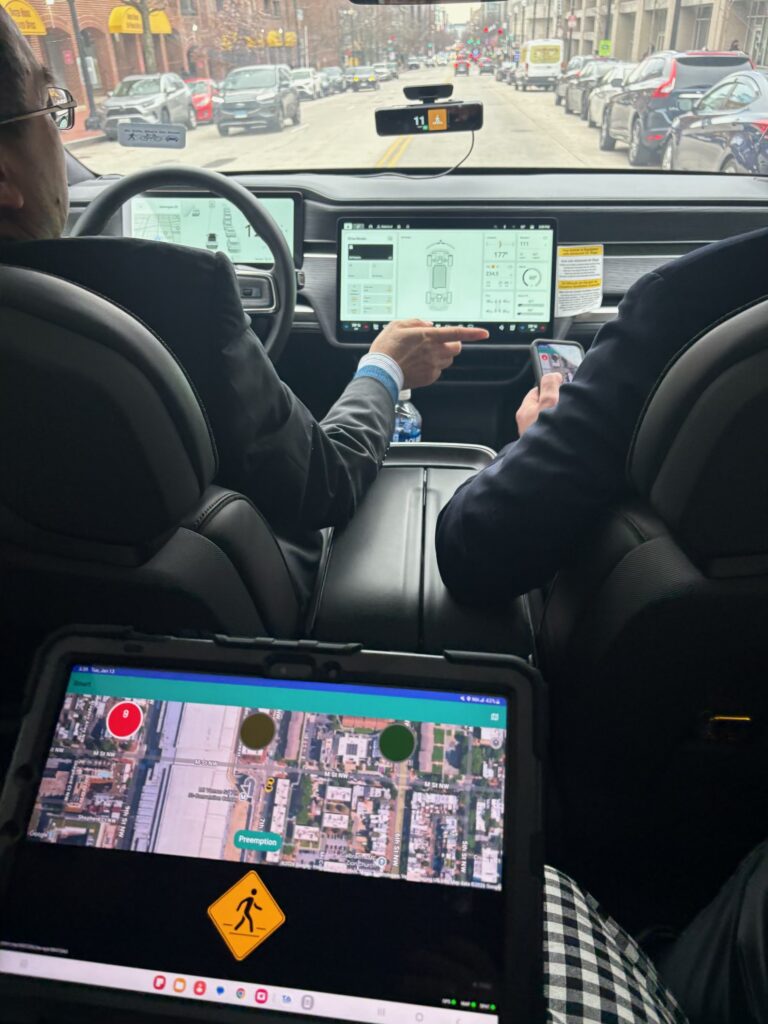
DDOT is seeking to accelerate V2X adoption to realize its inherent safety benefits. Led by Skye Guo, ITS Specialist, the team leverages those same Raven devices to receive data from Network V2X sources. Using the device’s built-in display, DDOT can now interface with the driver providing Traveller Information Messages (TIM), SpAT and MAP message directly into the cab, actively protecting the employees driving those vehicles.
“If we want to validate the V2X messaging services we’ve deployed, we need to be living it,” explains Skye. “By outfitting our own fleet with Raven first, we’re immediately providing our drivers with travel alerts and signal data they can’t get anywhere else, while proving the concept so that we can take a meaningful step towards vision zero.”
Enhanced Fleet Operations
Simultaneously, the fleet management team has been able to regain enhanced visibility and stay connected to employees in the field leveraging Raven’s AI Video Telematics Web App.
Unintended Consequences: The Power of Endless Applications
While the pilot was designed to solve specific infrastructure challenges, DDOT quickly discovered that having connected, searchable cameras in the field created incredibly valuable, novel use cases they hadn’t even anticipated.
- Location Sign Assets: When several roadways had some sign issues such as inconsistent signs, finding them manually would have been labor intensive. Using Raven’s imagery search function, John’s team could quickly locate the unapproved signs. This saved at least five days of manual scouting, preventing bad decision-making and unnecessary driving.
- Managing Construction Traffic Impacts: During a dignitary’s visit, the team learned their route would pass directly by an active paving site. DDOT used the Raven platform to pull a recent screenshot from a nearby device, confirming the exact paving location. The team quickly contacted staff and adjusted the site just prior to the arrival.
- Live-Streaming Emergency Events: When a vehicle battery fire broke out in a tunnel, the team identified a nearby DDOT rope truck equipped with a Raven device and pulled up a live feed of the incident through the video telematics interface. This gave the DDOT immediate, real-time situational awareness of the site and surrounding area.
- Locating Public Space Permit Issues: A simple search for “construction containers” or roll off dumpsters in the platform revealed sites where these dumpsters are still in place but permits have expired. This increases safety for roadway users and reduces the time staff spend checking on simpler permit types.
Setting the Tempo for Smart Cities
For DDOT, AI tooling isn’t about replacing human effort; it is about multiplying it and making the dollar of its citizens stretch further. The integration of the Raven platform is not just an upgrade to their vehicles, it is a shift to their organizational work flow.
Importantly, DDOT achieved this without compromising privacy. Raven’s flexible platform allows the agency to instantly disable cabin-facing cameras as required, ensuring full compliance with union and municipal privacy standards while retaining the immense value of external scanning.
By uniting Ground Source Truth, V2X communications, and AI-Video Telematics into a single, scalable ecosystem, DDOT is able to unblock hurdles in achieving its vision. They are successfully transitioning from reactive maintenance to real-time, proactive management, proving that with cross-departmental collaboration and the right technology, public agencies can build safer, smarter, and more efficient cities for all residents.


Comments are closed